Wednesday, March 23, 2022

One for All, All for One

Offloading my ship by helocopter due to enemy ground fire
CC Jean Stimmell cc 1967

I was mesmerized by a scene I saw on TV at the beginning of the Russian invasion of Ukraine: A group of neighbors with rifles guarding a suburban street leading into Kyiv against approaching tanks, their faces illuminated by fires they had lit in trashcans to keep warm, fearless and immovable, belting out in unison the Ukrainian National Anthem.


When everything is on the line, we forget our differences and come together as one.  Of course, we do: as social animals, it has been bred into us. That’s why we have survived as a species.


Although much less dire, I once was in a similar situation in the Navy during the Vietnam War. Our ship shuttled tanks, supplies, and sometimes troops along the coast and up the rivers of Vietnam. Occasionally, we had a significant crew turnover when guys rotated home; on one such occasion, almost a quarter of the crew was new. 


On our return trip from the Philippines, all hell broke loose in a crude kind of diversity training, representing as we did, a cross-section of the nation: East coast, highly educated, college dropouts and midwestern kids who hadn’t finished high school; hip city slickers and country folks right off the farm; We had Native American, Hispanic, and black sailors, along with staunch segregationists from the south.


It started with some pushing and shoving, harsh words, and a few fistfights, but, after day after day at sea, a certain equilibrium was achieved. We had other things on our minds. Sometimes, we had to be offloaded by helicopter because of enemy ground fire; once, shuttling around the Mekong Delta, the crew didn’t set foot on dry land for three months while garbage mounted up in the 120-degree heat, and we were reduced to saltwater showers.


We were a scruffy lot but did our jobs like well-oiled machines. If we got stuck on a sand bar in a river, we lowered landing boats to push us free. And it was up to us to defend our own perimeter when offloading cargo solo at desolate spots in the jungle. 


On November 1, 1968, shortly after I had returned to civilian life, Vietcong divers partially sunk our ship on the My Tho River. According to the official records, the 25 killed in action in the mining of Westchester County were “the U.S. Navy’s greatest single-incident combat loss of life during the entire Vietnam War.”⁠1 The death toll could have been much worse! But reacting quickly, amidst the screams of the injured in pitch-black darkness, crew rose to the occasion, turning valves to pump water into ballast tanks, preventing the ship from capsizing.


Staying alive in Vietnam was a mighty unifying force, putting on hold the cultural war raging back home in America. Today we are at war again – and I’m not talking about Russia, or our cultural polarization, which, while severe, is only a symptom of a deeper problem: the autocracy that rules our nation.  


Like Russia, we have our own super-rich oligarchs: At the top of the list, according to Forbes, are Elon Musk, Jeff Bezos, and Bill Gates, who now own more wealth than half of our population.⁠2 Worse yet “ProPublica found [in most] recent years, Musk, Bezos, and many of their fellow billionaires paid zero federal income taxes even as their fortunes soared.”⁠3


Like oligarchs everywhere, their unlimited resources enable them to tip elections in their favor. Conversely, as confirmed by Pew research, the average citizen has virtually no influence. Dark money and the fossil fuel industry spare no expense in shifting the blame away from themselves for causing our nation’s massive inequality – and the existential dangers of climate change – by spreading propaganda, distrust, and polarization.


These corporate titans now pit populists against progressives in the same manner that plantation owners pitted poor whites against blacks – while the elite merrily made money off both groups. Today the war we must fight is against this rampant inequality and looming environmental disaster.


That's the new war we must fight. Like the Ukrainians are doing, we must stand shoulder to shoulder to stop it. Our families and loved ones are on the line, along with all our fellow inhabitants of Space Ship Earth.

xxx


anImage_38.tiff

1 https://www.historynet.com/uss-westchester-county-attacked-during-the-vietnam-war/

2 https://en.wikipedia.org/wiki/List_of_wealthiest_Americans_by_net_worth⁠1

3 https://www.thenation.com/article/economy/pandemic-rich-richer/?utm_source=Sailthru&utm_medium=email&utm_campaign=Daily%203.22.2022&utm_term=daily

Tuesday, March 15, 2022

Seeking New Prophets: Bob Dylan and Volodymyr Zelenskyy?


The Beginning or the End?


I believe in science and the scientific method, testing each hypothesis to see if it is true. And, most important, as more evidence accumulates, changing the theory to stay in synch. There is no doubt the phenomena science studies, it knows well. But for the rest, it knows not.


That's why I'm always open to a more intuitive and more inclusive source of knowledge, the kind written about by Michael Mead: He is a scholar of mythology who has an uncanny ability to tap into ancestral sources of wisdom and connect them to the stories we are living  today.⁠1


For the same reason, I've always had a soft spot for Carl Jung, one of the most renowned psychologists of the 20th century. He went beyond where traditional science was willing to go. He believed in synchronicity, that everything happens for a reason; and he thought that we have a collective unconscious, a more profound way of knowing that humanity holds in common. Furthermore, he thought this collective unconscious could manifest itself in certain individuals. 


It happened to Jung himself when he fell ill in 1913. He thought he was going insane because of his reoccurring, bloody visions of worldwide carnage and destruction. Soon after, World War I erupted out of nowhere with unimaginable bloodshed – over 22 million lost their lives. Jung no longer questioned his sanity, realizing his dreams and visions were a premonition of war.


Well, maybe, you say, that was just coincidence or the rambling of a deluded, old, pointy-headed intellectual. Okay. Then let's take another example: Bob Dylan, son of a furniture store owner from a gritty mining town of Hibbing, MN, a nomadic waif who hitchhiked to NYC at age 20 to become the voice of his generation, the oracle who could express what was blowing in the wind, something we all felt but tongue-tied to say. 


One could make the case that Dylan's words were another manifestation of Jung's collective unconscious. His powers defied science and logic. From the beginning, he played only what he wanted to, not necessarily what the audience called for. And he was superbly gifted: the magnificence of his lyrical prose earned him the Nobel prize in 2016 "for his unique ability to prove that lyrics can go deeper than simple rhymes: they can become works of literature."⁠2


His talent came from a source somewhere beyond himself. In an interview on 60 minutes, he said his songs flowed from a mysterious "wellspring of creativity." He took no credit for writing his lyrics, saying they magically came to him. To me, his songs appear to be a manifestation of our collective unconscious, the wisdom we hold in common, the wellspring of our humanity. 


His songs cut through the clutter of evening news body counts and talking head blather to look straight into the face of the existential crises we face. The perils of the past loom larger each day. One song, in particular, "A Hard Rain's A-Gonna Fall," could not be more topical. Dylan wrote it during the Cuban Missile Crisis when we feared our world was coming to an end.


“And what'll you do now, my blue-eyed son?

And what'll you do now, my darling young one?

I'm a-goin' back out 'fore the rain starts a-fallin'

I'll walk to the depths of the deepest dark forest

Where the people are many and their hands are all empty

Where the pellets of poison are flooding their waters

Where the home in the valley meets the damp dirty prison

And the executioner's face is always well hidden

Where hunger is ugly, where souls are forgotten

Where black is the color, where none is the number

And I'll tell and speak it and think it and breathe it

And reflect from the mountain so all souls can see it

And I'll stand on the ocean until I start sinkin'

But I'll know my song well before I start singin'

And it's a hard, it's a hard, it's a hard, and it's a hard

It's a hard rain's a-gonna fall”⁠3


Scientific equations and high-tech algorithms can't solve the enormity of our problems. What is needed is access to the deeper knowledge as expressed by Dylan and mythology in general, described so well in a recent review of Michael Mead's latest book:


“As nature rattles and culture unravels, mythic imagination tries to return to the world, for endings and beginnings are particularly mythic. When "the End" seems near, how people imagine the world becomes more important; how people imagine humanity becomes of the utmost importance. Meade shows how "myth makes meaning" and helps a person find the meaningful path through life…


“When it appears that there's no time left, it isn't time that people need, but the touch of the eternal. While explaining how culture renews itself from the dreams of youth and the visions of elders, Meade introduces the concept of becoming ancient again by connecting to the eternal youth and the old soul within.”⁠4


Remember what Dylan predicted, “For the loser now will be later to win for the times they are a-changin’” We must honor the deep wisdom of our new prophets like the folksinger from Hibbing and the comedian from Ukraine. 

xxx


anImage_29.tiff

1 https://www.mosaicvoices.org/about

2 https://www.askqotd.com/bob-dylan/

3 https://www.azlyrics.com/lyrics/bobdylan/ahardrainsagonnafall.html

4 https://www.goodreads.com/book/show/4916225-the-world-behind-the-world


Tuesday, March 8, 2022

A Rant: Finding our Way Home


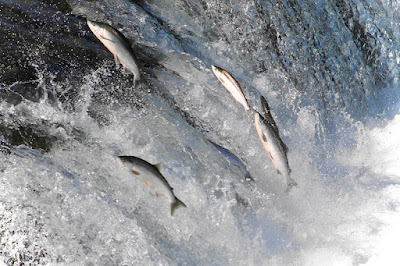
Salmon Returning Home
By Katmai NPS CC 2.0 license


I’ve written about how wonderful the Hope Lodge is, a compassionate and  revitalizing pitstop while enduring the barren desert of radiation and toxic chemicals. But still, it was not home. As a result, I’m beginning to feel like a plant marooned in a plastic pot, uprooted from my native soil. I felt that way in Vietnam, waiting my turn to come home. And I feel that way today. 


But this time around, I have a better idea of where this alienation is coming from, both in my own life and in the societal turmoil raging around us today. We are rapidly losing a foundational component of who we are as humans: our sense of place.


We have long been losing our sense of place, forced to move frequently, like nomads, to satisfy the demands of modern society; we are programmed to work hard all week so we can binge on the weekend. Then on Monday, we begin all over again, like Sisyphus repeatedly pushing that boulder up the mountain for eternity. 


Nevertheless, we have persevered: it’s the American way, and we are good at it. That is until the boom fell.


First Covid-19 erupted out of nowhere, throwing a hand grenade into the orderly routine of our lives, locking us claustrophobically in our homes, away from the comfort and camaraderie of friends. Like a giant experiment, it has unhinged us. While the rich cavorted in nature, we atrophied in the stale air of our rooms. Meanwhile, social media bombarded us with tales of doom and gloom from an endless barrage of fake news. 


Solitary confinement is how you break prisoners. And that’s what Covid did to us. Over time, we became delusional, incapable of trusting ourselves because the world has gotten too complex to figure out on our own. And we lost trust in experts because they talk in a thousand different tongues – which seem to change by the week. Meanwhile, we’re besieged by conspiracy theories – some even by our former president – that may sound at first glance as believable as anything else.


What a can of worms!


 We used to be empowered because we knew how to play this game of life. But now the rules have changed: we no longer are the exceptional people, the most favored of all nations, the king of the hill. Instead, we feel climate change’s hot breath burning our backsides while Covid mows us down. Polarization has caused our neighbors to become our enemy. And now, a significant war, erupting like a sulfurous volcano, threatens to engulf all of Europe, if not the world.


Explaining this malaise, naysayers have pronounced that the old game of democracy is dead. They complain that the Big Truths honoring morality and fair play are holding us back. In its place, these malcontents are busy devising new games with simple, easy-to-follow rules. I’m talking about folks like our neighbors who have fallen down the rabbit hole of alternative realities like QAnon.


My ravings are not just that of a patient, addled by too much radiation: it’s the conclusion of the philosopher and game theorist, C. Thi Nguyễn, who in his recent book, “Games, Agency As Art,”⁠1 came up with this notion. He writes that the lure of conspiracy theories, like QAnon or the Flat-Earth Society, is about putting yourself in charge of your own little world, “in which you can manage everything, in which you can understand everything.” 


His research reveals that people hooked on conspiracy theories “say over and over again” how it has empowered them. And the reason, he says, “is the conspiracy theories fit inside your head. They’re the right size for you just like games are the right size for you to take some kind of action.”⁠2 


These conspiracies, which conjure up alternative realities where everything is relative, anything is permissible, and morality doesn’t exist, have had a hypnotic appeal to extremists. That is, until recently, when objective reality reasserted itself: Overnight, Putin’s barbaric and brutal invasion of Ukraine popped the bubble of all these pie-in-the-sky fantasies.


At last, old virtues, like human dignity and democracy, are back in vogue. Once again, we are witnessing how a sense of place is worth fighting for – and even dying for –  as Ukrainians stream back to their spiritual homeland from around the globe to take on Russian tanks with crowbars and Molotov cocktails. 


Regaining our sense of place is a vital component in rebuilding trust in each other, necessary to building a better world. Otherwise, we are like salmon swimming in circles biting each other in frustration because we have forgotten the way home

.xxx


anImage_158.tiff

1 https://www.nytimes.com/2022/02/25/opinion/ezra-klein-podcast-c-thi-nguyen.html?showTranscript=1

2 ibid.


Wednesday, February 23, 2022

E. B. White on My Mind


"E B White quote" by Kathleen Tyler Conklin is licensed under CC BY 2.0


I sometimes berate myself for the amount of time I spend trying to write. I have no trouble coming up with an idea, but as I write, another thought pops up, and then another, until pretty soon, I've composed a jumbled and inarticulate mess. It takes a lot of time and many revisions to distill the piece down into something smooth and easy to read – that actually says what I want to say.


Recently, I had an insight, after observing what pleasure older folks get spending hours assembling jigsaw puzzles at the medical residence where I am staying. They told me it was relaxing, making time fly by. That struck a nerve with me because that's precisely what writing does for me.   


Rather than berating myself for wasting so much time, I should be rejoicing that I have such an all-consuming passion  - even if all I ever did with my writing was delete it when I finished, like puzzle solvers do when the game is over, putting the pieces back in the box.


But more than that, writing helps to organize my thoughts. In the process of rewriting, I am able to distill vague thoughts and feelings into clear articulations, previously only indistinct whispers, like the sound of the sea lapping up against the beach. I’ve always considered my writing a personal pursuit. But E. B.White, my favorite essayist, believed writers have a responsibility to society.


White is best known for writing iconic children’s books like “Charlotte’s Web.” But he was, first and foremost,  a celebrated writer for adults, considered one of the finest essayists of the 20th century. The Christian Science Monitor praised him for crafting personal essays that, more than three decades after his passing, endure as exemplars of the form.”


Here's a quote from one of my favorites, "One Man's Meat," a collection of his essays about life at his beloved saltwater farm in rural Maine, where he resided a good part of the year.


“Old stone walls ran into the woods, and now and then there would be an empty barn as a ghostly landmark. The night grew frosty and the ground underfoot was slippery with rime. The bare birches wore the stars on their fingers, and the world rolled seductively, a dark symphony of brooding groves and plains.”⁠1 


But I digress. As I started to say, writing was more than a craft for White; it was an obligation, which he described this way: while “a writer should concern himself with whatever absorbs his fancy…I do feel a responsibility to society because…a writer has the duty to be good, not lousy; true, not false; lively, not dull; accurate, not full of error. He should tend to lift people up, not lower them down. Writers do not merely reflect and interpret life, they inform and shape life.”⁠2


He felt “a writer must reflect and interpret his society… [providing] inspiration and guidance and challenge.” He was a sage ahead of his times, who recognized, over 50 years ago, the rise of a disturbing trend in social media. And he didn’t like it: "Much writing today strikes me as deprecating, destructive, and angry.”⁠3  


I appreciate E. B. White in many ways: He was an optimist: “All that I hope to say in books, all that I ever hope to say, is that I love the world.” He was kind: “By helping you, perhaps I was trying to lift up my life a trifle. Heaven knows anyone’s life can stand a little of that.” (From Charlotte’s Web). He was a philosopher: “Life’s meaning has always eluded me and I guess it always will. But I love it just the same.”⁠4 


And most of all, he understood my muddled method of writing: “A great deal of writing is not "plotted"—most of my essays have no plot structure, they are a ramble in the woods, or a ramble in the basement of my mind.”⁠5 

xxx


anImage_110.tiff

1 One Man's Meat by E.B. White

2 https://www.themarginalian.org/2012/04/17/e-b-white-paris-review-interview/

3 Ibid.

4 https://www.kent-teach.com/Blog/post/2015/07/11/15-wonderful-quotes-from-e-b-white.aspx

5 https://www.thoughtco.com/writers-on-writing-e-b-white-1692831

Sunday, February 20, 2022

Befriending My Winter of Discontent

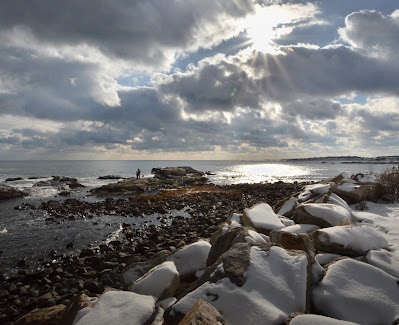
Sunset on Jenness Pond
CC Jean Stimmell: 11/28/14


Wandering through life for the last 76 years, I've wintered in various places:  from cruising the rivers of Vietnam to laying water lines in the frozen sand of Cape Cod to vacationing off-grid in New Mexico at 7200 feet. But this Winter has been unique, spending six weeks at the Hope Lodge in Boston, an excellent refuge run by the American Cancer Society, accommodating folks like me undergoing chemo and radiation treatment. Here at Lodge, we are quite a club: forged by our common affliction, we combat the noxious side effects of cancer treatment with humor and compassion.


Due to the combination of Covid, plus our lowered immune system, we stay locked down with no visitors allowed, which is fine with me. Hibernating in winter has long been my choice, like the bear in Finnish  mythology, who hunkers down in winter hoping to be reborn in the spring.⁠1


That coincides with what Katherine May says in her well-received book, “Wintering:” If I befriend this cyclical rhythm, I can “emerge from the coldest season of the soul not only undiminished but  revitalized.⁠2  Rainer Maria Rilke wrote similarly about winter as the season for tending to the inner garden of the soul: “Suddenly to be healed again and aware that the very ground of my being — my mind and spirit — was given time and space in which to go on growing,”⁠3 


While it's fine and dandy for Rilke to putz around in his literary garden, my flash and blood garden feels like it has been plowed under by a John Deere tractor. Of course, it's all for a good cause: the proton radiation machine combined with toxic chemicals is designed to break up and kill the malignant clots in my soil, the first step in promoting healthy new growth.


No one said it would be easy. According to May: ‘wintering’s not  just a cold season, but “a fallow period in life when you're cut off from the world, feeling rejected, sidelined, blocked from progress, or cast into the role of an outsider." 


For May, her winter of discontent began after a series of family crises piled on top of a long history of depression. The only way she was able to pull through – while, at the same time finishing her book – was by recognizing winter for what it was:  “Winter is the time of withdrawing from the world, maximizing scant resources… and vanishing from sight; but that’s where the transformation occurs. Winter is not the death of the life cycle, but its crucible.”⁠4


She had some tricks up her sleeve: “When I started feeling the drag of winter, I began to treat myself like a favoured child: with kindness and love…I kept myself well fed and made sure I was getting enough sleep. I took myself for walks in the fresh air and spent time doing things that soothed me.”⁠5 I’m doing the same. Plus, having Russet here to tend to me has been a godsend. 


But it is no cakewalk. In Day’s words, "wintering is usually involuntary, lonely, and deeply painful." It's about riding on the roller coaster of nature's whims. Sometimes I live up to my aspirations, mindful as a yoga meditating by a still pond under a clear sky. But other times, I lose it altogether; my brave words swept away in a tsunami of pain, diarrhea, and numbing fatigue.


I keep in mind what wise woman, Pema Chodon, has written: "when things fall apart," we have a real opportunity for transformative change, but without reflection, it may be squandered." May tells us: "This is a crossroads… a moment when you need to shed a skin. If you do, you'll expose all those painful nerve endings and feel so raw that you'll need to take care of yourself for a while. If you don't, then that skin will harden around you."⁠6


Once, after taking pain-killing drugs, I had a nightmare about accruing bad karma, payback for those psychological experiments I conducted at Columbia, studying stimulus and response by shocking white rats. But mostly, I daydream about escaping from these invasive medical interventions, along with the hubbub of the big city, to return home to blossom anew amidst the lady slippers and trilliums.

xxx


anImage_47.tiff

1 https://www.fairychamber.com/blog/bears-in-finnish-mythology-video

2 https://www.themarginalian.org/2021/03/06/wintering-katherine-may/

3 https://www.amazon.com/Letters-Young-Woman-Northwestern-Classics/dp/0810127407

4 May, Katherine. Wintering . Penguin Publishing Group. Kindle Edition. P.13

5 Ibid. Page 237

6 Ibid, page 14


Friday, February 11, 2022

Born of Uncertainty a New Day is Dawning


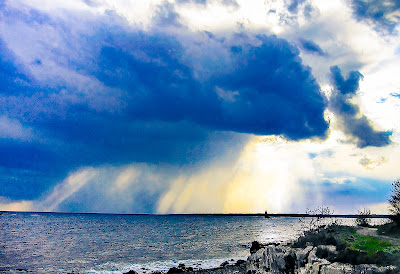
Approaching Storm
CC Jean Stimmell, Fort Foster
Kittery, Maine: 2013


No wonder we are beside ourselves, confronting a whole menagerie of 800-pound gorillas: the never-ending Covid pandemic, impending war with Russia, climate change disaster,  and fundamental challenges to our democracy, just to name a few. When subjected to this never-ending horror show, our first instinct is to stick our heads in the sand.


No one likes doomsday tales, especially me – and I try not to write them. Still, it is imperative to acknowledge the enormity of what we are facing so we can make necessary adjustments. While it is society's task to reduce greenhouse gases, provide vaccines against Covid-19, and deal with other dangers of that ilk, it is our role as individuals to acknowledge we are entering uncharted territory that require course corrections.


Professor and author Timothy Morton calls these looming perils, bigger than human beings can comprehend, ‘hyperobjects.’ He says the first step in conquering our fear is admitting that these threats are real. By doing so, rather than paralysis, we will find catharsis. "Our sense of “the world” might be ending, but humans are not doomed. In fact, the end of this limited notion of the world may also be the only thing that can save us from ourselves.”⁠1 


He writes that learning to cope with these momentous perils will force us to move beyond our individualistic society, which “alienates us from each other and leave us ill-prepared to cope with hyperobjects.” Instead, we will discover that our fates and our suffering are defined in large part “by invisible, systemic forces pressing down upon us.” Out of that crucible, Morton concludes, ‘We’re being born now’—standing on the precipice not of becoming post-human, but of becoming truly human for the first time”.⁠2


As a former psychotherapist, the last thing I want is to cause pain. That's why I have been transitioning my columns from being a Paul Revere, calling out the alarm, to a stance more philosophical and therapeutic. My writing now is more directed toward how we can achieve the most out of our lives during these trying times. I frequently cite the Tao Te Ching written by Lao-Tzu in the 4th or 5th century BC and Michel de Montaigne's essays, published in 1580. Despite living through periods of chaos and terror far worse than our own, both men offer timeless wisdom on how to live satisfying and meaningful lives.


I have also been transformed by reading Buddhist authors, like Jon Aaron, on ways to go with the flow. Now, when stressed, I recite 'embrace uncertainty' like a mantra; it lifts from my shoulders the dead weight of all those things I can't control, flooding me with a sense of serenity, similar, I think, to what  long-term AA members get from reciting 'Let go, let God.'


Kaira Jewel Lingo, who worked closely with the venerable Thich Nhat Hanh, practices a similar approach in her personal life: “By slowing down, by choosing to rest back into the uncertainty rather than fighting it, I was able to touch into a sense of space, precisely in moments when it felt like there was no way to keep going and I would be totally overwhelmed.”⁠3


I will close by quoting Lingo, who, while not sugarcoating the magnitude of what is rushing madly toward us, explains, once again, why we must surrender to the process to come out the other side:


“In a sense, our culture, our society is dissolving. We are collectively entering the chrysalis: structures we have come to rely on and identify with are breaking down, and we don’t know what the next phase will be like. We are in the cocoon. Learning to surrender in our own lives is essential to our collective learning to move through this time of faster and faster change.”⁠4 

xxx

anImage_107.tiff

1 https://www.wired.com/story/timothy-morton-hyperobjects-all-the-way-down/

2 Ibid.

3 https://tricycle.org/magazine/buddhism-decision-making/?utm_source=Tricycle&utm_campaign=61a360f7d0-Daily_Dharma_02_05_2022_S&utm_medium=email&utm_term=0_1641abe55e-61a360f7d0-307712649

4 Ibid.

Sunday, February 6, 2022

The Embodied Mind: A New Way of Thinking


I took this photograph at the Museum of Fine Arts in Boston. If you look carefully,
you can see me at the instant I took the photo in the upper right hand corner of the
image. But it is not really me but a reflection, reflecting not reality but a digital
image. That makes sense in Eastern philosophy where self is considered an
illusion: Nothing in and of itself but merely a reflection of all that surrounds us.


In America, we place individual rights over the needs of society, probably more than any other country. We place human beings over nature. We place mind over body. And we worship our free-market economic system requiring perpetual growth – which exists nowhere else in nature except in cancer. 


That’s the paradigm we live under. But what if none of it is true?


That was the position Gregory Bateson took, whom I became enamored of while in graduate school; he was an acknowledged genius across multiple disciplines, as well, at least for a while, Margaret Mead’s husband.  According to him, the mind isn't locked inside our bony skulls but extends out into our bodies, the objects we use, the people we know, and, ultimately, into all of society and nature beyond. He spelled out this thesis in  “Steps to an Ecology of Mind.”⁠1


Bateson’s vision was considered wacky when he proposed it in the 1960s, but it is going mainstream today: “The idea that our stomachs and heart have a say in how we think and feel and that Google is now part of our brains may not seem that controversial. However, most of us aren’t ready to swallow the notion that when a mathematician solves an equation using a whiteboard, that his thinking actually takes place on the whiteboard itself.”⁠2


Nevertheless, according to the philosopher Andy Clark, now a leading light in this field, the tools we use to help us think, whether language, smartphones, or whiteboards, are all the same: they are part of thought itself.⁠3 He contends that these props are what sets us apart from animals, whose brains are quite similar to ours. “The difference is due to our heightened ability to incorporate props and tools into our thinking, to use them to think thoughts we could never have otherwise.”⁠4

What Clark does find ridiculous is the notion that pure thought is possible. He asks us to remember what role our brain’s intelligence played at the beginning of human evolution: it wasn’t abstract thinking, but to assist us in “running away from predators and toward mates and food. A mind’s first task, in other words, was to control a body.” 

Clark is one of the most-cited philosophers alive. He has inspired research in  neuroscience, psychology, linguistics, artificial intelligence, robotics, and other disciplines more distant. The Extended Mind has become a hot topic, now renamed “The Embodied Mind” because, in essence, the body is the mind.

Academics across all these fields have found, quite unexpectedly, that their research coincides with the core teachings of Buddhism: both the idea that the independent self is an illusion, and that nothing on earth stands complete, in and of itself. Instead, all things arise in relation to other things: "if this exists, that exists; if this ceases to exist, that also ceases to  exist".⁠5

That concept is beautifully expressed in the Buddhist metaphor “Indra’s Net,” first referenced in India over 3000 years ago.

There is an endless net of threads throughout the universe…

At every crossing of the threads there is an individual.

And every individual is a crystal bead.

And every crystal bead reflects

not only the light from every

other crystal in the net

but also every other reflection

throughout the entire universe.⁠6


The embodied mind thesis may sound like pure woo-woo, yet it may be a necessary paradigm change if we are to survive as a nation – and, perhaps, as a species.

Put into practice, it would upend our current worldview where we are pigeonholed as separate, independent actors, solely responsible for our own lives: forced to play the game of survival of the fittest, competing against our neighbors for scarce resources. Instead, by taking off our blinders, we can aspire to who we really are: Each of us, a precious jewel reflecting all our fellow beings, animate and inanimate, in earth's vast ecosystem.

xxx

anImage_65.tiff

1 Gregory Bateson. Steps To an Ecology of Mind (1972).

2 http://howtoseethoughts.org/extended-mind/

3 https://www.newyorker.com/contributors/larissa-macfarquhar

4 https://www.newyorker.com/magazine/2018/04/02/the-mind-expanding-ideas-of-andy-clark

5 https://en.wikipedia.org/wiki/Pratītyasamutpāda

6 http://jeanstimmell.blogspot.com/2011/03/reflections-and-indras-net.html