Sunday, February 20, 2022

Befriending My Winter of Discontent

Sunset on Jenness Pond
CC Jean Stimmell: 11/28/14


Wandering through life for the last 76 years, I've wintered in various places:  from cruising the rivers of Vietnam to laying water lines in the frozen sand of Cape Cod to vacationing off-grid in New Mexico at 7200 feet. But this Winter has been unique, spending six weeks at the Hope Lodge in Boston, an excellent refuge run by the American Cancer Society, accommodating folks like me undergoing chemo and radiation treatment. Here at Lodge, we are quite a club: forged by our common affliction, we combat the noxious side effects of cancer treatment with humor and compassion.


Due to the combination of Covid, plus our lowered immune system, we stay locked down with no visitors allowed, which is fine with me. Hibernating in winter has long been my choice, like the bear in Finnish  mythology, who hunkers down in winter hoping to be reborn in the spring.⁠1


That coincides with what Katherine May says in her well-received book, “Wintering:” If I befriend this cyclical rhythm, I can “emerge from the coldest season of the soul not only undiminished but  revitalized.⁠2  Rainer Maria Rilke wrote similarly about winter as the season for tending to the inner garden of the soul: “Suddenly to be healed again and aware that the very ground of my being — my mind and spirit — was given time and space in which to go on growing,”⁠3 


While it's fine and dandy for Rilke to putz around in his literary garden, my flash and blood garden feels like it has been plowed under by a John Deere tractor. Of course, it's all for a good cause: the proton radiation machine combined with toxic chemicals is designed to break up and kill the malignant clots in my soil, the first step in promoting healthy new growth.


No one said it would be easy. According to May: ‘wintering’s not  just a cold season, but “a fallow period in life when you're cut off from the world, feeling rejected, sidelined, blocked from progress, or cast into the role of an outsider." 


For May, her winter of discontent began after a series of family crises piled on top of a long history of depression. The only way she was able to pull through – while, at the same time finishing her book – was by recognizing winter for what it was:  “Winter is the time of withdrawing from the world, maximizing scant resources… and vanishing from sight; but that’s where the transformation occurs. Winter is not the death of the life cycle, but its crucible.”⁠4


She had some tricks up her sleeve: “When I started feeling the drag of winter, I began to treat myself like a favoured child: with kindness and love…I kept myself well fed and made sure I was getting enough sleep. I took myself for walks in the fresh air and spent time doing things that soothed me.”⁠5 I’m doing the same. Plus, having Russet here to tend to me has been a godsend. 


But it is no cakewalk. In Day’s words, "wintering is usually involuntary, lonely, and deeply painful." It's about riding on the roller coaster of nature's whims. Sometimes I live up to my aspirations, mindful as a yoga meditating by a still pond under a clear sky. But other times, I lose it altogether; my brave words swept away in a tsunami of pain, diarrhea, and numbing fatigue.


I keep in mind what wise woman, Pema Chodon, has written: "when things fall apart," we have a real opportunity for transformative change, but without reflection, it may be squandered." May tells us: "This is a crossroads… a moment when you need to shed a skin. If you do, you'll expose all those painful nerve endings and feel so raw that you'll need to take care of yourself for a while. If you don't, then that skin will harden around you."⁠6


Once, after taking pain-killing drugs, I had a nightmare about accruing bad karma, payback for those psychological experiments I conducted at Columbia, studying stimulus and response by shocking white rats. But mostly, I daydream about escaping from these invasive medical interventions, along with the hubbub of the big city, to return home to blossom anew amidst the lady slippers and trilliums.

xxx


anImage_47.tiff

1 https://www.fairychamber.com/blog/bears-in-finnish-mythology-video

2 https://www.themarginalian.org/2021/03/06/wintering-katherine-may/

3 https://www.amazon.com/Letters-Young-Woman-Northwestern-Classics/dp/0810127407

4 May, Katherine. Wintering . Penguin Publishing Group. Kindle Edition. P.13

5 Ibid. Page 237

6 Ibid, page 14


Friday, February 11, 2022

Born of Uncertainty a New Day is Dawning


Approaching Storm
CC Jean Stimmell, Fort Foster
Kittery, Maine: 2013


No wonder we are beside ourselves, confronting a whole menagerie of 800-pound gorillas: the never-ending Covid pandemic, impending war with Russia, climate change disaster,  and fundamental challenges to our democracy, just to name a few. When subjected to this never-ending horror show, our first instinct is to stick our heads in the sand.


No one likes doomsday tales, especially me – and I try not to write them. Still, it is imperative to acknowledge the enormity of what we are facing so we can make necessary adjustments. While it is society's task to reduce greenhouse gases, provide vaccines against Covid-19, and deal with other dangers of that ilk, it is our role as individuals to acknowledge we are entering uncharted territory that require course corrections.


Professor and author Timothy Morton calls these looming perils, bigger than human beings can comprehend, ‘hyperobjects.’ He says the first step in conquering our fear is admitting that these threats are real. By doing so, rather than paralysis, we will find catharsis. "Our sense of “the world” might be ending, but humans are not doomed. In fact, the end of this limited notion of the world may also be the only thing that can save us from ourselves.”⁠1 


He writes that learning to cope with these momentous perils will force us to move beyond our individualistic society, which “alienates us from each other and leave us ill-prepared to cope with hyperobjects.” Instead, we will discover that our fates and our suffering are defined in large part “by invisible, systemic forces pressing down upon us.” Out of that crucible, Morton concludes, ‘We’re being born now’—standing on the precipice not of becoming post-human, but of becoming truly human for the first time”.⁠2


As a former psychotherapist, the last thing I want is to cause pain. That's why I have been transitioning my columns from being a Paul Revere, calling out the alarm, to a stance more philosophical and therapeutic. My writing now is more directed toward how we can achieve the most out of our lives during these trying times. I frequently cite the Tao Te Ching written by Lao-Tzu in the 4th or 5th century BC and Michel de Montaigne's essays, published in 1580. Despite living through periods of chaos and terror far worse than our own, both men offer timeless wisdom on how to live satisfying and meaningful lives.


I have also been transformed by reading Buddhist authors, like Jon Aaron, on ways to go with the flow. Now, when stressed, I recite 'embrace uncertainty' like a mantra; it lifts from my shoulders the dead weight of all those things I can't control, flooding me with a sense of serenity, similar, I think, to what  long-term AA members get from reciting 'Let go, let God.'


Kaira Jewel Lingo, who worked closely with the venerable Thich Nhat Hanh, practices a similar approach in her personal life: “By slowing down, by choosing to rest back into the uncertainty rather than fighting it, I was able to touch into a sense of space, precisely in moments when it felt like there was no way to keep going and I would be totally overwhelmed.”⁠3


I will close by quoting Lingo, who, while not sugarcoating the magnitude of what is rushing madly toward us, explains, once again, why we must surrender to the process to come out the other side:


“In a sense, our culture, our society is dissolving. We are collectively entering the chrysalis: structures we have come to rely on and identify with are breaking down, and we don’t know what the next phase will be like. We are in the cocoon. Learning to surrender in our own lives is essential to our collective learning to move through this time of faster and faster change.”⁠4 

xxx

anImage_107.tiff

1 https://www.wired.com/story/timothy-morton-hyperobjects-all-the-way-down/

2 Ibid.

3 https://tricycle.org/magazine/buddhism-decision-making/?utm_source=Tricycle&utm_campaign=61a360f7d0-Daily_Dharma_02_05_2022_S&utm_medium=email&utm_term=0_1641abe55e-61a360f7d0-307712649

4 Ibid.

Sunday, February 6, 2022

The Embodied Mind: A New Way of Thinking


I took this photograph at the Museum of Fine Arts in Boston. If you look carefully,
you can see me at the instant I took the photo in the upper right hand corner of the
image. But it is not really me but a reflection, reflecting not reality but a digital
image. That makes sense in Eastern philosophy where self is considered an
illusion: Nothing in and of itself but merely a reflection of all that surrounds us.


In America, we place individual rights over the needs of society, probably more than any other country. We place human beings over nature. We place mind over body. And we worship our free-market economic system requiring perpetual growth – which exists nowhere else in nature except in cancer. 


That’s the paradigm we live under. But what if none of it is true?


That was the position Gregory Bateson took, whom I became enamored of while in graduate school; he was an acknowledged genius across multiple disciplines, as well, at least for a while, Margaret Mead’s husband.  According to him, the mind isn't locked inside our bony skulls but extends out into our bodies, the objects we use, the people we know, and, ultimately, into all of society and nature beyond. He spelled out this thesis in  “Steps to an Ecology of Mind.”⁠1


Bateson’s vision was considered wacky when he proposed it in the 1960s, but it is going mainstream today: “The idea that our stomachs and heart have a say in how we think and feel and that Google is now part of our brains may not seem that controversial. However, most of us aren’t ready to swallow the notion that when a mathematician solves an equation using a whiteboard, that his thinking actually takes place on the whiteboard itself.”⁠2


Nevertheless, according to the philosopher Andy Clark, now a leading light in this field, the tools we use to help us think, whether language, smartphones, or whiteboards, are all the same: they are part of thought itself.⁠3 He contends that these props are what sets us apart from animals, whose brains are quite similar to ours. “The difference is due to our heightened ability to incorporate props and tools into our thinking, to use them to think thoughts we could never have otherwise.”⁠4

What Clark does find ridiculous is the notion that pure thought is possible. He asks us to remember what role our brain’s intelligence played at the beginning of human evolution: it wasn’t abstract thinking, but to assist us in “running away from predators and toward mates and food. A mind’s first task, in other words, was to control a body.” 

Clark is one of the most-cited philosophers alive. He has inspired research in  neuroscience, psychology, linguistics, artificial intelligence, robotics, and other disciplines more distant. The Extended Mind has become a hot topic, now renamed “The Embodied Mind” because, in essence, the body is the mind.

Academics across all these fields have found, quite unexpectedly, that their research coincides with the core teachings of Buddhism: both the idea that the independent self is an illusion, and that nothing on earth stands complete, in and of itself. Instead, all things arise in relation to other things: "if this exists, that exists; if this ceases to exist, that also ceases to  exist".⁠5

That concept is beautifully expressed in the Buddhist metaphor “Indra’s Net,” first referenced in India over 3000 years ago.

There is an endless net of threads throughout the universe…

At every crossing of the threads there is an individual.

And every individual is a crystal bead.

And every crystal bead reflects

not only the light from every

other crystal in the net

but also every other reflection

throughout the entire universe.⁠6


The embodied mind thesis may sound like pure woo-woo, yet it may be a necessary paradigm change if we are to survive as a nation – and, perhaps, as a species.

Put into practice, it would upend our current worldview where we are pigeonholed as separate, independent actors, solely responsible for our own lives: forced to play the game of survival of the fittest, competing against our neighbors for scarce resources. Instead, by taking off our blinders, we can aspire to who we really are: Each of us, a precious jewel reflecting all our fellow beings, animate and inanimate, in earth's vast ecosystem.

xxx

anImage_65.tiff

1 Gregory Bateson. Steps To an Ecology of Mind (1972).

2 http://howtoseethoughts.org/extended-mind/

3 https://www.newyorker.com/contributors/larissa-macfarquhar

4 https://www.newyorker.com/magazine/2018/04/02/the-mind-expanding-ideas-of-andy-clark

5 https://en.wikipedia.org/wiki/Pratītyasamutpāda

6 http://jeanstimmell.blogspot.com/2011/03/reflections-and-indras-net.html

Saturday, January 29, 2022

The Downfalls of Smart Technology


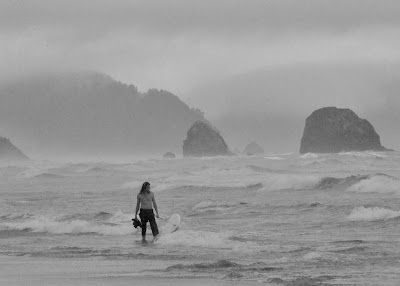
Cannon Beach Oregon 9/19/13
CC Jean Stimmell


My partner has a smartwatch, and it enriches her life because she is mindful about how she uses it. I used to be among the first to embrace new technology but now feel increasingly threatened by it, prompting me to build a seawall against this onrushing digital tide.


While I love email because I can leisurely respond when I have a free moment, I hate texting because it hits me over the head, interrupting my train of thought, already fragile at my advanced age. I previously alternated between a desktop with a big screen to edit photos and a laptop, but they drove me crazy because of synching problems. 


So I downsized, trading in my desktop to purchase a big screen monitor to use with my laptop. For me, a smartwatch is beyond the pale: I have neither the time nor the patience to make peace with another device. More important, I don't want to be interrupted while peacefully daydreaming or strolling in my woods, striving to lose myself in nature. But most critically, I am shunning the smartwatch because it threatens my ability to live inside my own skin.


As Lindsay Crouse recently wrote about the smartwatch in the NYT: "It can interfere with our ability to know our own bodies. Once you outsource your well-being to a device and convert it into a number, it stops being yours. The data stands in for self-awareness. We let a gadget tell us when and how to move, when we're tired, when we're hungry."⁠1 


Performance expert Brad Stulberg, author of" The Practice of Groundedness," observes how we measure success in our culture by how much we achieve and smart devices play right into that: "It's like you're trying to win at this game instead of living your life. Instead of learning what your body feels like, you have a number."⁠2

Crouse writes about how her smartwatch became an addiction causing her to crave its approval: "These devices don't just record your behavior — they influence it and keep you coming back. You become dependent on external validation."⁠3 


At present, I'm reading "The Wakeful Body" by Willa Baker, who is a Buddhist teacher and writer. She warns that even experienced meditators often get marooned in their heads: "If truths that we know with the conceptual mind or that we glimpse with intuition do not make it down into the body and nervous system, we will not truly live them."⁠4 


She describes a series of practices to “wake down,” designed to leave behind our conceptual minds, which – if I were designing the program – would include getting rid of smartwatches. By doing so, she says, we don’t lose anything because our humanness lies inside us: Experiencing what is happening in our bodies "right here and right now is enough. It is more than enough. The here and now is the very stuff of liberation."⁠5


It isn't easy to convey the depth of Barker's thesis. One reason, she says, is because "[w]hile prose is the language of the mind, poetry is the language of the body. "


In the spirit of celebrating the body through poetry, I will close by repeating her quote by Kabir Das, the 15th-century Indian mystic poet and saint:


Be strong then, and enter into your own body; 

there you have a solid place for your feet. 

Think about it carefully! 

Don't go off elsewhere! Kabir says this: just throw away all thoughts of imaginary things, 

and stand firm in that which you are


xxx


anImage_5.tiff

1 https://www.nytimes.com/2022/01/28/opinion/smartwatch-health-body.html?campaign_id=2&emc=edit_th_20220129&instance_id=51666&nl=todaysheadlines&regi_id=30753738&segment_id=81117&user_id=273ae8c1ede4fde7d59a2b0627accb92

2 Ibid

3 Ibid

4 Baker, Willa. The Wakeful Body (p. 7). Shambhala. Kindle Edition.

5 ibid.

Sunday, January 16, 2022

A Sense of Place: The mind thinks, but the body knows

My family's ashes are sprinkled around this oak.
I cut the granite stone to mark the spot.


A friend of mine wondered if she would be remembered after she died. An answer sprung up unprovoked from somewhere inside me: Of course, you will, I said. You will always be remembered like Julius Caesar is because some of the same molecules Caesar breathed you are inhaling right now. He is inside you, part of our shared humanity. That’s why none of us will be forgotten. 


My mind thought the story I had told her to cheer her up was a gross exaggeration. But my body, like an indigenous shaman, knew better, casting a spell over me, which I only discovered later when I took a walk: My beloved woods had magically come alive; the air I was breathing became a fortune teller revealing my past.


As I walked by a fallen log by a twin towering oak tree, I remembered being there with my father breathing the same air now he was breathing when he had showed me on that fallen log how to skin a fisher I had shot stalking my chickens, 50 years ago.


I remember my mother and me picking blueberries on the adjoining 21 acres of land that my father bought for $100.00 cash, which they later gave to me, upon which I built the house in which I am now sitting. On the day in question, I remember we were terrified after stumbling upon a bear, also berry hunting, both of whom I hold so close, breathing the same air molecules as they did, 70 years ago.


Then I catch a glimpse of the rascally deer who are decimating my rhododendrons. I welcome them as descendants of the deer my grandfather, a real animal lover, used to commune with, sitting on his favorite stump nearby. I rejoice breathing in the same air molecules that coursed through the deer and my grandfather, who was also named Jean, 100 years ago.


Under my spell, past and present merged as ghosts of my family’s past gathered with me under that same red oak tree where mom, dad, and my brother’s ashes now rest. The branches of the trees creak in the cold, and my friend Raven, croaks as he flies by. No longer mortal, the world and I merge as one.


Getting home, I googled the alleged story about how we all share Caesar’s breath. Eureka! Science has confirmed it! According to BBC Science Focus Magazine: A breath seems like such a small thing compared to the Earth’s atmosphere, but remarkably, if you do the math, you’ll find that roughly one molecule of Caesar’s air will appear in your next breath”⁠1  – and one molecule from  Cleopatra, Einstein, your grandmother, and even that bear in the woods.


None of us will ever be forgotten.


xxx


anImage_11.tiff

1 https://www.sciencefocus.com/planet-earth/are-we-really-breathing-caesars-last-breath/

Wednesday, January 12, 2022

Take this job and shove it


"Quit Now" by fuzzcat is licensed under CC BY 2.0


Last spring, Republican governors in a dozen states, including NH, prematurely terminated the additional $300/month unemployment benefit, paid for by the federal government stimulus program. Republicans claimed this bonus made workers lazy, encouraging them to loll around playing video games rather than going to work.


Multiple reputable studies prove Republicans are wrong. Some employees stayed home to take care of their kids, while others feared catching Covid. Others refused to return, not because they wanted to play hooky but because they hated their jobs and were looking for something better.


The federal stimulus program is now long gone, but folks continue to quit in droves. It is garnering headlines, and stacks of articles and books are being written about it. Why are people still quitting? Not surprisingly, the lowest-paid workers are leaving most often. Their jobs are the ones that tend to be dead-end without benefits: repetitive, boring, and sometimes dangerous.


A raft of self-help books have sprung up, purporting to solve the problem, usually by advising readers to reinvent their lives during the hours they are not working. These books may help upper-middle-class folks who have the financial resources and leisure time to pursue new hobbies and passions. But these rosy scenarios are pie in the sky to most working folks, tolling for long hours, often at two or more jobs, struggling just to get by.


This refusal is not a result of individual laziness but reflects long-standing American policy decisions that hamstring the average worker. It’s a fact that the voices of poor and low-income people, over 40% of our population, have been silenced in the national political conversation.⁠1  Not surprisingly, studies show that workers are happiest in countries, such as in Western Europe, which provide a generous safety net: universal health care, childcare, welfare, and a secure retirement. Conversely, we provide, at best, just a faint echo of these robust programs. 


Conservatives rejoice over this, believing that people are shiftless and won’t work unless threatened with draconian poverty. Of course, the happy yet still productive workers in places like Finland prove them wrong. The real problem is big business and corporations which have a fiscal mandate to maximize profits; they achieve this objective by bleeding wage-earners for every last dime they can while refusing to pay their fair share of taxes – if they pay any taxes at all– to further the common good.


This has lead to popular unrest and resentment, which our former president capitalized upon. But, sadly, rather than lifting up working folks through policies like Biden is proposing, Trump chose to fan the flames of our smothering cultural divisions.


In a sick sort of way, if the Republicans successfully block the Democrat’s agenda to lift up the average Joe, they will win twice by rewarding their big corporation donors while, at the same time, driving more increasingly desperate and angry workers into Trump’s camp. They will do this, like they did last election, by promising their base the freedom to openly carry assault rifles, to keep out immigrants, and to ignore any regulations they don’t like.


That’s a recipe not for freedom but anarchy. However, right under our noses, there is a way to increase individual freedom, simply by removing the straight jacket of how we define work. As Kathi Weeks, a feminist scholar, writes,  “I think what you’re seeing with people refusing to go back [to work] is a kind of yearning for freedom.” …that our society is entirely too obsessed with work, that employment is not the only avenue through which to derive meaning in life and that sometimes no job is better than a bad job.⁠2


Defining our lives solely on how we make money has turned us into commodities. As author David Frayne writes, “For all the propaganda we hear about work as a source of good health and a way to ‘meet potential’, work so often seems to stand in the way of people realising what they are capable of in terms of their capacities for creation and co-operation.⁠3


The whole notion of what work entails needs to be expanded to include the work we do taking care of our family, the work we do in service to our community, and the work we do making our world better through volunteer work. To achieve that goal, we need a more generous safety net, following the lead of enlightened countries around the world.


A  good case in point is Finland which has been named the happiest place on earth for the fourth straight year, based on Gallup World Poll Data, which included measures of social support, personal freedom, and gross domestic product (GDP).⁠4


Let's start to catch up by passing Biden's "Build Back Better" bill.

xxx


anImage_56.tiff

1 https://www.epi.org/publication/moral-policy-good-economics/?utm_source=Economic+Policy+Institute&utm_campaign=e9ae3f2da0-EMAIL_CAMPAIGN_2021_11_17_COPY_01&utm_medium=email&utm_term=0_e7c5826c50-e9ae3f2da0-60589414&mc_cid=e9ae3f2da0&mc_eid=d51abe8850

2 https://www.nytimes.com/2021/10/22/opinion/work-resignations-covid.html?action=click&module=RelatedLinks&pgtype=Article#after-story-ad-1

3 The Refusal of Work by David Frayne. Zed Books. London. www.zedbooks.co.uk

4 https://www.bbc.com/news/world-europe-56457295

Thursday, January 6, 2022

Why Habits Are Important

Surveying my woodpile, a few years past


In the latest Harper's magazine,⁠1 Meghan O'Gieblyn writes an extended meditation on habits, covering both the pros and the cons. On one extreme, she says, are the techies who think ditching habits would be "unimaginably great." That's how I felt when I was young, driven by testosterone and the turbulent times of the 1960s: I craved to be unleashed, to run free and unfettered from restraints of any kind.


O’Gieblyn covers every contingency but, in the end, makes a strong case for why good habits are indispensable, enlisting the support of wise luminaries from the past like Seneca, St. Benedict, and William James. They all agree on the importance of spontaneity but say that’s not sufficient: To live a life of purpose with tranquility and composure, “this first nature” has to be combined with “the second nature” of habit.⁠2 Progressively, as I’ve grown older, I’ve gravitated to this second position.


One revelation that changed me came from reading the Myth of Sisyphus by Camus. Sisyphus, of course, was that guy from Greek mythology who was condemned to repeat forever pushing a boulder up a mountain, only, just before reaching the top, to have it roll back down. When I first read that book in my twenties, I thought Sisyphus’s fate was worse than death.


However, rereading it in my forties –  perhaps it helped that I was working by then as a stonemason– I no longer thought getting up every morning to lift stones, day after day, year after year, was such a horrible fate.  It turned out to be a satisfying way of life, especially if one had enough beer to drink. I think Camus and I agree, based on how he ended his book:“The struggle itself is…enough to fill man’s heart. One must imagine Sisyphus happy.”⁠3


A second revelation also came in my forties from reading The Miracle of Mindfulness by Thich Nhat Hanh while pursuing my graduate degree in counseling at Antioch. He became my mentor, demonstrating why good habits were crucial even when doing a mundane task, like washing dishes:


“If while washing dishes, we think only of the cup of tea that awaits us, thus hurrying to get the dishes out of the way, then we are not “washing the dishes to wash the dishes.” What’s more, we are not alive during the time we are washing the dishes. In fact we are completely incapable of realizing the miracle of life while standing at the sink. If we can’t wash the dishes, the chances are we won’t be able to drink our tea either. While drinking the cup of tea, we will only be thinking of other things. Thus we are sucked away into the future—and we are incapable of actually living one minute of life.”⁠4 


At one point in her essay, O’Gieblyn concludes since repetition is a component of all ascetic traditions, she thinks her “own habits constitute something like a spiritual discipline.” I feel the same way, especially since, sadly, my nature veers toward procrastination and disorder. Learning to form mindful habits to accomplish essential tasks has made my life more orderly and stress-free. The payoff comes when these new habits become rituals, opening up space to be spontaneous.


No longer attempting to juggle multiple tasks all at once, I now delight  from mindfully doing one thing well.  I especially enjoy being grounded in my physical body while working with my hands. The first thing that comes to mind is cutting firewood. It’s a joyful act I know I share with my wood-burning pals: that real sense of accomplishment that comes from seeing our woodpiles grow longer in preparation for the long winter ahead.


It’s a habit I’ve honed over the years that connects me to something bigger than myself: By participating in the sacred dance of Nature by cutting up cull trees off my land in winter, hauling the pieces out to be stacked in the summer’s sun, and, finally, carrying them into the house to be burned in winter, I warm both body and soul. 


As Meghan O'Giebyn found out, in a different context, my ritual of woodcutting "constitutes something like a spiritual discipline." It makes me feel aligned with the universe.

xxx


anImage_2.tiff

1 https://harpers.org/archive/2022/01/routine-maintenance-embracing-habit-in-an-automated-world-meghan-ogieblyn/

2 ibid. page 31

3 Albert Camus, Myth of Sisyphus. 1942

4 Thich Nhat Hanh, The Miracle of Mindfulness: An Introduction to the Practice of Meditation